Inside a kitten's brain
How kittens build a map of the world
We often hear that kittens need to be socialised between two and seven weeks of age.
But why? What is actually happening inside their brain?
A kitten's brain isn't simply growing. It's rapidly building its first understanding of what the world is.
Understanding what is happening in a kitten's brain can help you forge a great friendship when you welcome a new kitten into your home.
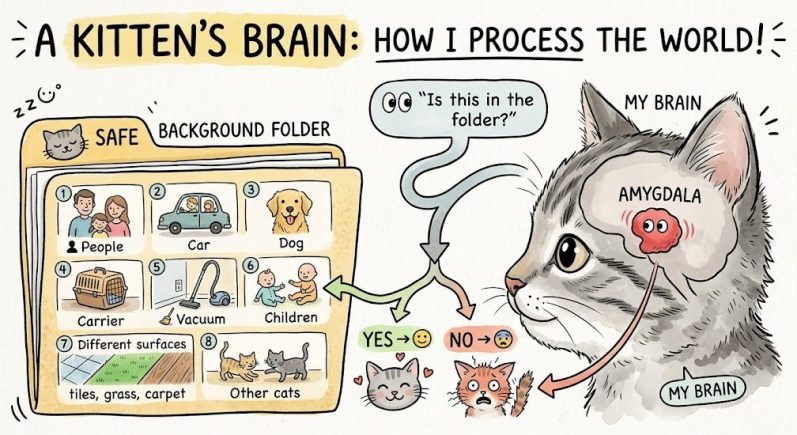
Creating a Safe Background Folder
We call the period when kittens are between two and seven weeks the socialisation window because it is when we can, through gentle handling, create cats that are happy and comfortable around people. This is obviously important for us (and them!) and the reason we can do this is because the kitten's brain is a mass of rapidly connecting neurons absorbing data to create a "Safe Background Folder” of sensory inputs. Information logged by the brain as normal, safe, background elements of the environment.
It's also important that a kitten gets as many experiences as possible, to fill up that folder with all the things that they may experience later in life. Anything that the kitten experiences now becomes part of the neural map that experience can refine later. So whilst it is critically important that kittens have human touch logged away in that folder, it will make the kitten's next phase of brain development easier if all the raw material is there. That means: floor surfaces, carriers, dogs, children, vacuum cleaners, vets, and litter trays.
Whilst as behaviourists we focus on the socialisation period for that reason, there is a second phase of brain development that is also important in developing confident cats. This is the juvenile peak of the 'experience-dependent' phase of neuroplasticity and it's happening at 10 to 12 weeks of age, and that’s when many people become guardians of a new kitten.
How play builds brains
At ten to twelve weeks of age the main brain structure is already locked in, but the connections within that structure are highly malleable. Between two and twelve months, the juvenile and adolescent cat uses intense play and exploration to rapidly adjust the neural map. This is the pruning and strengthening period of neurogardening! Neurons that are associated with meaningful data are strengthened and others pruned away.
You may see a kitten running up the curtains or pouncing on scattered litter. What you aren't seeing is intense myelination inside the brain. But it is happening! This wrapping of neurons in a myelin sheath increases neural transmission speeds up to 100-fold. This correlates directly with the behavioural milestone of peak object or predatory play and makes the neural pathways of stalk, pounce, and catch lightning-fast superhighways. The brain is 'locking in' the motor skills required for complex predatory calculations, transforming a clumsy kitten into an agile predator.
Why fear changes everything
What is also happening as this shift from creating a map to refining it occurs, is that the limbic system is becoming much more influential in the kitten's behaviour. This is important because this includes the amygdala, which is where fear is processed. The early neuroplastic brain feeds on data, but exploration and approaching something you have never seen before could be deadly for a kitten. If it's not in the Safe Background Folder, then it is 'a new thing,' and a new thing triggers fear in the older kitten. This neophobia is a survival tactic, and whilst we may want to nurture this older kitten, if they have never seen a person before, we are a strange and scary predator and the default fear response is to flee, to hiss, growl, or fight.
There is also another aspect of the developing limbic system, and that is memory. At ten to fourteen weeks, a kitten’s hippocampus (the seat of explicit, long-term memory) is, like the amygdala, shifting to become structurally mature. Unlike a four week-old kitten whose memories are fleeting and require constant reinforcement, a twelve week-old kitten has the neural architecture to create permanent, and strong memory files.
So what does that all mean when you are bringing your new kitten home? Your kitten has their Safe Background Folder already in place, and you aren't in it, and neither is your home. So your kitten is likely to be very fearful at first, with the amygdala working overtime as they are surrounded by new things. However, if they were well-raised, they should have 'person' and 'room' in the folder. Because their brain connections are still malleable, all you have to do is show that the information they already have labelled as safe is relevant to you too. Give them a place to hide to manage their emotions whilst providing them evidence that you are good (so that will be food then!) and avoiding anything that may heighten their fear, like loud noises or being picked up and moved around.
The importance of memory (and you)
You also need to consolidate all that raw information into useful memories. A kitten’s socialisation to travelling to the vet at six weeks of age will become meaningless if it isn't repeated when they are older. The memory is fleeting and the neurons associated with it may be pruned away. Repeating that for an older kitten helps consolidate those neural pathways that mean vet trips are normal. You also have to take things calmly and make it a positive experience. Remember, we are taking the amygdala to the vet too!
So now we get to the part you already know. The best thing you can do with your new kitten is play! Their brains are primed to strengthen the neural pathways associated with becoming a little hunter, and it's fun. A play session not only makes those neural pathways faster and faster, it also releases a lot of dopamine. That rush of dopamine is more rewarding than any treat, it quietens the fear messages of the amygdala, it creates a bright, vivid, good memory of you, and importantly it teaches your kitten that you are part of the fun.